
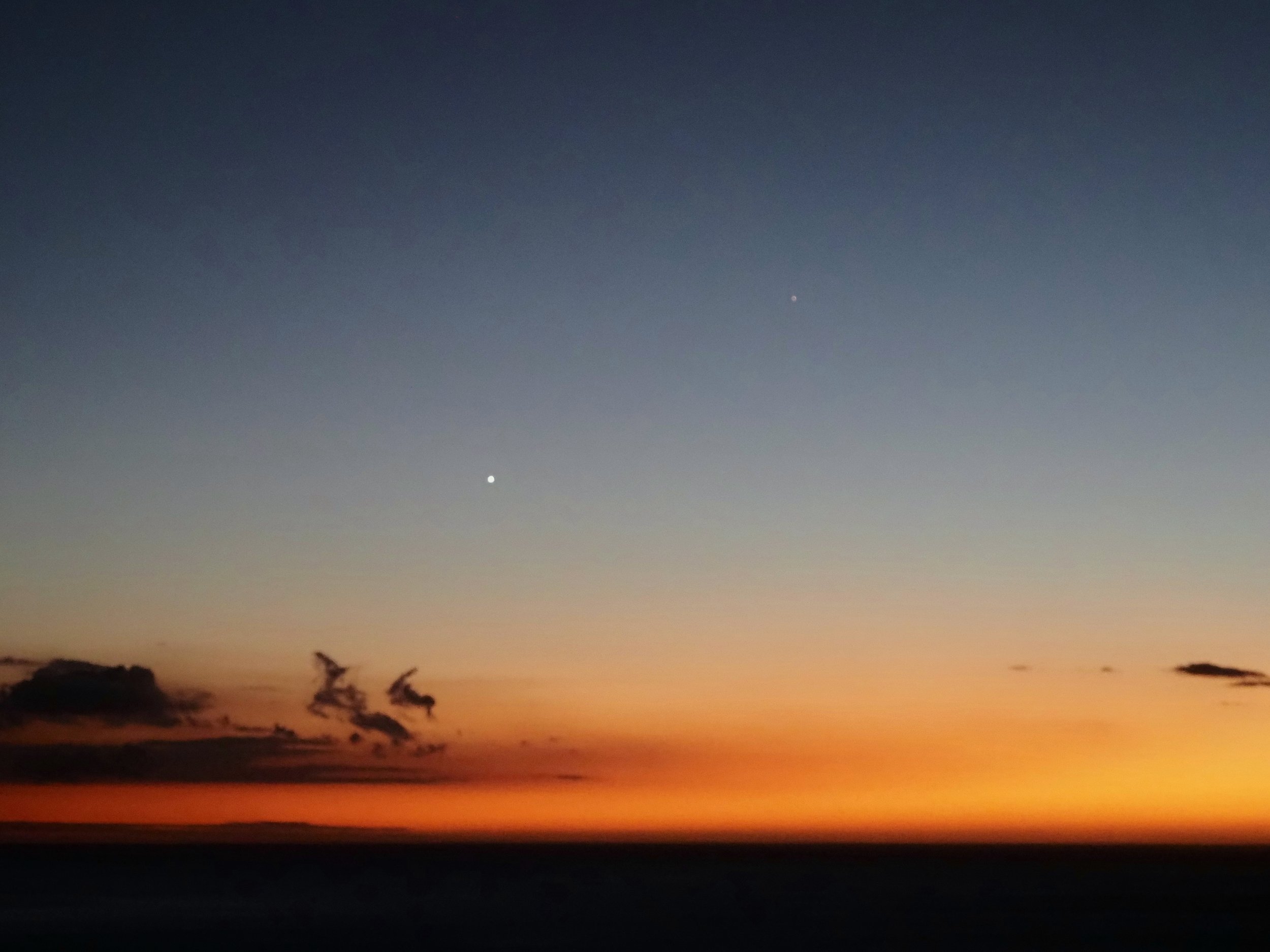
Venus after sunset, looking west-southwest from north of Kawaihae, Hawaii, October 5, 2026, 6:44 PM.
Venus is probably astrology’s most assumed planet. Say “Venus” and most people immediately think love, maybe beauty, and move on. That’s not wrong, but it’s incomplete. Understanding what Venus governs, beyond the surface, matters right now, because Venus turned retrograde on October 3, 2026 and stays that way until November 13. It is the only Venus retrograde of the year and the first since the spring of 2025.
What Venus Governs
Named for the Roman goddess of love (the Greeks called her Aphrodite), Venus has represented love, beauty, and harmony across essentially every astrological tradition that has ever existed: Mesopotamian, Hellenistic, Greek, Roman, and Vedic. But “love” undersells it. Venus governs attraction in the broadest sense: what you’re drawn to, what you consider beautiful, and - maybe most practically - your own values. Not abstract principles, but the real things you choose to spend your time, money, and attention on.
In Hellenistic astrology, Venus was classified as a benefic planet, generally associated with ease and pleasure rather than struggle. The tradition assigned her rulership of two signs, Taurus and Libra, and considered her placement in Pisces her “exaltation” - the sign where Venus’s capacity for love was thought to reach its most selfless, unguarded expression.
Why Venus Retrograde Is Rare
Mercury goes retrograde three or four times a year, which is why it gets so much attention. Venus retrogrades about once every 19 months, and each period lasts about six weeks. The last one ran from March 1 to April 12, 2025. That rarity is part of why astrologers treat it as more significant than a typical Mercury retrograde. It doesn’t come around often enough to become routine.
There is a lovely pattern behind it. Each Venus retrograde lands in a different part of the zodiac, and over eight years the five of them trace a five-pointed star around the sky. This one falls in Scorpio and Libra.
What Actually Happens During Venus Retrograde
Nothing external reverses. Venus doesn’t move backward. From Earth’s vantage point, the planets’ orbits create an optical illusion of backward motion as Venus swings between us and the Sun. That happens around October 23, 2026, when Venus passes so close to the Sun that it is lost in the glare. Afterward it returns to the morning sky, rising before the Sun.
Astrologically, the tradition reads this apparent reversal as an invitation to review rather than launch - specifically, to review relationships, finances, and self-worth, the exact three areas Venus governs.
This is where the pattern across sources gets specific and consistent. Old relationships or unresolved feelings tend to resurface during this period, not because anything is destined to go wrong, but because a review period naturally pulls up what hasn’t been fully settled. People sometimes notice they have been shrinking themselves to keep a relationship peaceful. Spending habits get a second, more careful look against what someone values versus what they’ve been buying out of habit.
Where This One Lands
This Venus retrograde began on October 3 in Scorpio, at about 8 degrees. Venus then moves ‘backward’ through Scorpio and slips into Libra around October 25, and it turns direct again on November 13 at about 23 degrees of Libra. It returns to Scorpio, moving forward again, around December 4.
Scorpio adds real intensity to the review, with themes of trust, intimacy, and shared resources rather than Venus’s usually lighter touch. Libra, a sign Venus rules, brings the questions back to partnership, fairness, and balance: what do I give, what do I receive, and is it even?
(Dates use U.S. Eastern time. Hawaii is a few hours behind, so in Hawaii the retrograde began on the evening of October 2.)
Is It Affecting More People Than Just Me?
Probably in the way astrologers would describe it: Venus is in everyone’s chart, so everyone’s money, relationships, and sense of worth are invited to review at the same time. In astrology the sky is shared, and the planet is the same for all of us, even though it touches each of us differently.
Where it lands in your own chart changes what it feels like. Astrologers say the review is usually felt most by people who have a planet or an important point (such as the Ascendant) in the stretch of the zodiac Venus covers going back and forth, from about 23 degrees of Libra to about 8 degrees of Scorpio. Venus crosses that stretch three times, once forward, once back and once forward again, which is why it can feel like a theme that comes back around.
A fair caution: astrology is a language of symbols, and it can’t prove a cause. If it is stirring up thoughts about money, relationships, or your sense of self-worth, that is real and worth noticing, and it can be useful to treat it as a prompt to reflect and not as a prediction.
What This Doesn’t Mean
Traditional astrological advice during Venus retrograde leans toward caution about brand-new romantic commitments or major aesthetic decisions (a dramatic haircut, a tattoo) started during the window. That is not because they’re doomed, but because judgment in these specific areas is considered less reliable mid-review. It does not mean existing relationships are at risk. If anything, the consistent advice across sources is that established relationships often benefit from this kind of unhurried review.
What I’d Suggest Doing With This
Nothing dramatic. If an old friend or former partner reaches out during this window, that’s worth noticing rather than dismissing as coincidence. If you catch yourself buying something and can’t quite say why, that’s worth a second look too. A few questions to carry through to November 13: What do I actually value, and does the way I spend my time and money show it? Where have I been making myself smaller to keep the peace? Is there a relationship, old or current, that deserves a more honest conversation?
Venus retrograde isn’t a warning. It’s closer to an invitation to be clear with yourself about what you value, for about six weeks every nineteen months.
As always, astrology is a symbolic language for reflection, not a forecast.